Your doctor has arranged a meeting about your care

It's a short, secure meeting where your doctor talks with other health professionals about your care — sometimes to coordinate with people already involved, sometimes just to get expert advice from a specialist or allied health professional.

You don't need to attend — your doctor will talk it through with you afterwards.
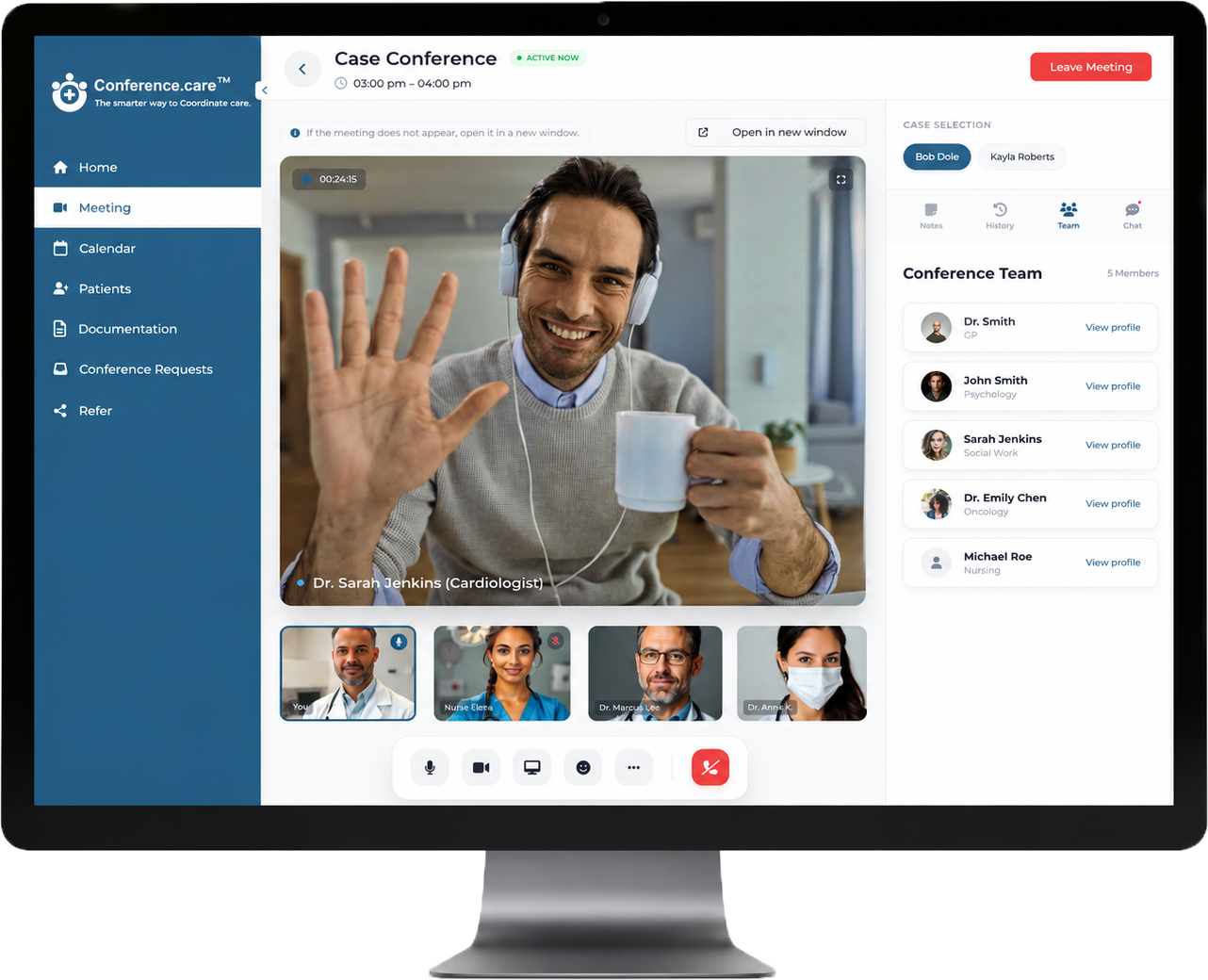
The Conference.care platform
Bulk billed —no cost to you

What is this meeting?

It brings your doctor together with other health professionals — specialists, physiotherapists, psychologists and others — at the same time, in one conversation. Some may already look after you; others your doctor brings in for their expert advice.

Instead of letters going back and forth between clinics, everyone talks it through together, in real time — so nothing is missed, nothing is doubled up, and everyone leaves working from the same plan.

It can do two things: coordinate with any professionals already involved in your care, and give your doctor a way to get advice from specialists and allied health professionals — including ones you may not have seen — without you needing a separate referral or appointment.
PhysiotherapistPhysiotherapist
PsychologistPsychologist
SpecialistSpecialist
Your doctorYour doctor

Why it's happening

Because your doctor wants the best plan for your care

Your doctor might arrange one to coordinate with the other professionals involved in your care so everyone's working from the same plan — or simply to get advice from a specialist or allied health professional about the best way forward. Either way, it means more expertise focused on your care, without you needing a separate referral or appointment.

You don't need to attend or prepare anything. Your doctor knows your history and leads the conversation, then talks the outcome through with you at your next appointment.

There's nothing you need to do. The meeting is part of your regular care — your doctor has organised everything, and you'll hear the plan from them afterwards.

Arranged by your own doctor

The doctor who looks after you set this up because it will help coordinate — and add to — your care.

Nothing for you to do

You don't need to attend, prepare, or fill anything in. Your doctor handles it all.

You'll hear the outcome

Your doctor will talk you through the agreed plan at your next visit — and it goes into your medical record.

Better care, backed by research

Studies consistently show that when care teams meet like this, patients' problems are picked up earlier, care plans work better, and hospital visits go down.

93%

of Australian patients in a recent study believe these meetings had a positive effect on their care.

Across many health settings, research consistently shows these multidisciplinary meetings:

  • Ensure patient problems are properly identified1
  • Generate more effective care plans2,3
  • Enhance clinical decision-making4,5
  • Reduce hospitalisations & ED presentations6
  • Improve symptom management and quality of life7,8
  • Reduce overall healthcare costs9

Cost & privacy

No cost to you — and your privacy is protected

Bulk billed

The meeting is covered by Medicare and bulk billed — there is no out-of-pocket cost to you, and nothing for your family to pay either.

Private & secure

The meeting is private and encrypted, and only the health professionals your doctor has involved in planning your care take part. Notes go into your medical record, just like a normal appointment.

Your consent respected

The meeting goes ahead as part of your care, but the choice is yours. You can opt out or withdraw your consent at any time — see your choices below.

Your choices

This is your care — and your choice

This meeting only involves your doctor and the health professionals they've asked to help plan your care, and it goes ahead as part of your normal care. But it's your health being discussed, so the decision is always yours.

You're free to decline — for example if you're away, or you'd simply rather your care wasn't discussed this way. Opting out won't affect the care you receive from your doctor in any other way.

How to opt out

If you'd prefer not to take part, or you have any questions, contact the Conference.care team at patients@conference.care. You can withdraw your consent at any time.

What is Conference.care?

Conference.care is a service that organises these meetings for doctors — we take care of the scheduling and the paperwork, so your doctor can focus on your care.

Questions? We're happy to help

If you have any questions about your meeting, the Conference.care team is here to help — just get in touch.

REFERENCES

  1. King MA, Roberts MS. Multidisciplinary case conference reviews: improving outcomes for nursing home residents, carers and health professionals. Pharmacy World & Science. 2001;23(2):41–5. Available from: https://doi.org/10.1023/a:1011215008000
  2. Agar M, Luckett T, Luscombe G, Phillips J, Beattie E, Pond D, et al. Effects of facilitated family case conferencing for advanced dementia: a cluster randomised clinical trial. PLoS ONE. 2017;12(8):e0181020. Available from: https://doi.org/10.1371/journal.pone.0181020
  3. Shelby-James T, Currow D, Phillips P, Williams H, Abernethy A. Promoting patient centred palliative care through case conferencing. Australian Family Physician. 2007;36(11):961–3. Available from: https://www.racgp.org.au/afp/200711/20754
  4. Phillips JL, West PA, Davidson PM, Agar M. Does case conferencing for people with advanced dementia living in nursing homes improve care outcomes: evidence from an integrative review? International Journal of Nursing Studies. 2012;50(8):1122–35. Available from: https://doi.org/10.1016/j.ijnurstu.2012.11.001
  5. Shelby-James T, Butow P, Davison G, Currow D. Case conferences in palliative care: a substudy of a cluster randomised controlled trial. Australian Family Physician. 2012;41(8):608–12.
  6. Vest JR, Blackburn J, Yeager VA, Haut DP, Halverson PK. Primary care-based case conferences and reductions in health care utilization. Journal of Health Care for the Poor and Underserved. 2021;32(3):1288–1300. Available from: https://doi.org/10.1353/hpu.2021.0132
  7. Reuther S, Dichter MN, Büscher I, Vollmar HC, Holle D, Bartholomeyczik S, et al. Case conferences as interventions dealing with the challenging behavior of people with dementia in nursing homes: a systematic review. International Psychogeriatrics. 2012;24(12):1891–1903. Available from: https://doi.org/10.1017/s1041610212001342
  8. Mitchell G, Del Mar C, O'Rourke P, Clavarino A. Do case conferences between general practitioners and specialist palliative care services improve quality of life? A randomised controlled trial. Palliative Medicine. 2008;22(8):904–12. Available from: https://doi.org/10.1177/0269216308096721
  9. Hollingworth S, Zhang J, Vaikuntam BP, Jackson C, Mitchell G. Case conference primary-secondary care planning at end of life can reduce the cost of hospitalisations. BMC Palliative Care. 2016;15(1). Available from: https://doi.org/10.1186/s12904-016-0157-9